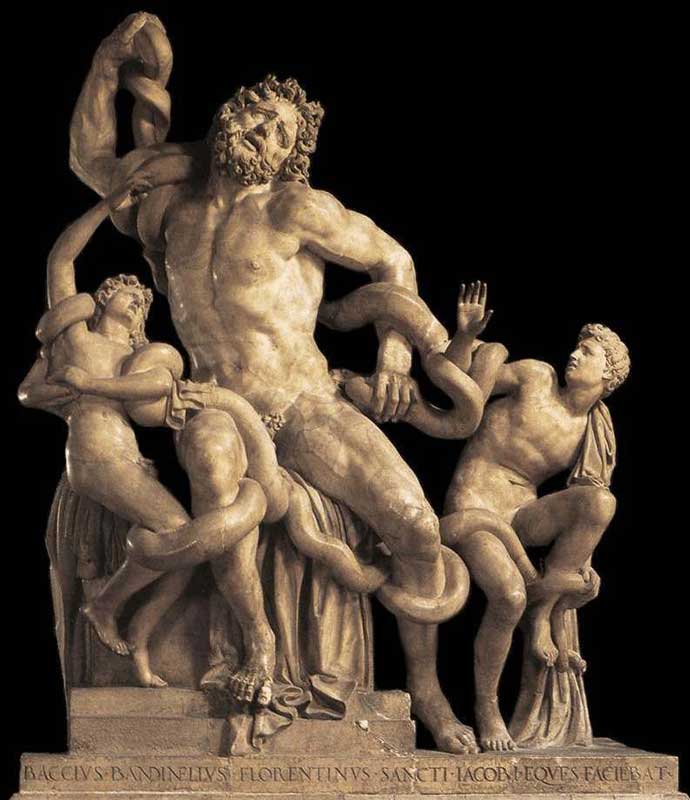
One of the first artworks seen in history that portrays movement and emotion is from the Greek time period, “Laocoon and his Sons.” One story behind the artwork is about a priest dedicated to serving the god Apollo, Laocoon, the father of the hero Aeneas, son of Agenor of Troy. Laocoon offended Apollo by breaking his oath of maintaining his celibacy and he had sexual intercourse with his wife within the sanctuary of Apollo. Upon sacrificing a bull on the altar of Poseidon with his two sons, they were crushed by two sea serpents as punishment for disgracing the gods.
A better-known story having to do with the sculpture has to do with Laocoon and how he had warned against accepting the Trojan horse left by the Greeks. As punishment for betraying his own people he and his sons would be eternally tortured by two serpents sent by the gods. Pliny accredited the sculpture to three Rhodian sculptors, Hagesandros, Polydoros and Athanadoros. The piece is now housed within the Vatican. The Pope of the Catholic Church was astounded by the sculpture and requested it for the Vatican.1
The sculpture is made of marble it was founded in the ruins of the palace of the emperor Titus. When it was founded by Pliny it only had Laocoon and one of his sons, which was then changed to conform to Vergil’s account in the “Aeneid.” Vergil had written about the strangling of Laocoon and his two sons, not one. It was believed that the second son had later been added for this reason.
The sculpture depicts Laocoon, nude and in agony in between his two sons. They are all in great fear of the two serpents surrounding and strangling them. Laoccon still portrays some important Greek sculptural aspects like the perfection of the body.1 He and his sons are in great physical condition, there is cloth draped over the pedestal and one of the sons shoulders, but not much is covered, you can see all aspects of their physique. This was important in Greek culture to depict the importance and greatness of the male body. Upon seeing the sculpture today you can only see one of the snake’s faces, however, it has been determined through the legend and through observation of the sculpture that there were in fact to snakes attacking Laocoon and his two sons. The face of the second snake was broken off, it was believed to have been jabbing at the face of Laocoon as he held its neck to pull it away.
Art in Motion
Art History 1 project presented by Briana Cabeza and David Garcia
Goldfish Salvation by Riusuke Fukahori
An artist who uses every day life as an inspiration is, Riusuke Fukahori. We see this within his work, “Goldfish Salvation.” This is a truly one of a kind work of art. This artist’s technique is perfect for our exhibition, since it captures the motion of the subject. Riusuke’s artwork is a combination of sculpture and painting. His highly-detailed work is done by meticulously layering acrylic paint with resin castings. This is done section by section, according to Designboom, “Fukahori builds up the fish with fleeting brushwork, resulting in an effect that resembles motion blur underneath water.” 2
Riusuke Fukahori’s work is often referred to as “living sculptures”. One look at them and it is easy to know why. The sculpture’s ultrarealistic detail and 3D features capture the delicacy and motion of nature. The way the goldfish are swimming is even accurate. They are swimming around their tank as they would in real life. There is also a tube that is providing oxygen for them, even detailing the bubbles coming up from the bottom.
The message of this artwork is supposed to be the animated life of the goldfish, or the cycle of life. As can be seen, there are new fish being introduced to the tank, and they’re swimming in a circular motion. As the new, smaller fish are swimming clockwise, you can see them get gradually larger, eventually ending in the spot where the new fish are being introduced. As the smaller fish are swimming, they multiply, and there is less space in between them. Even when you freeze a scene, which this artwork tries to do, there’s always so much going on in nature, one gets a feeling of motion and energy.
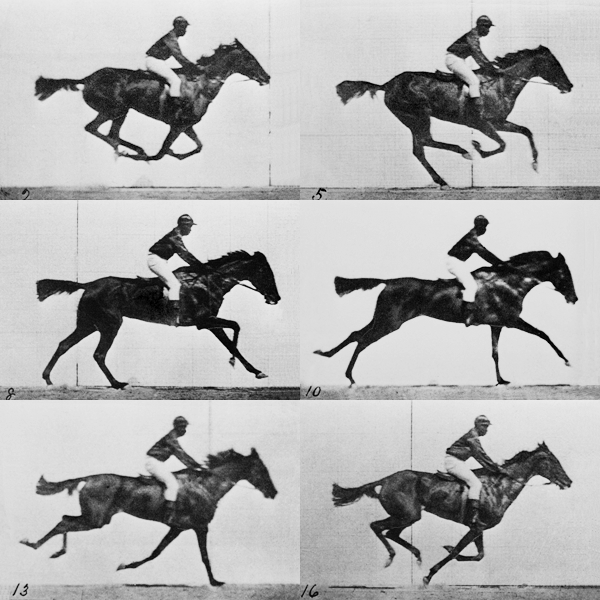
The Horse In Motion by Eadweard Muybridge
Eadweard Muybridge’s photo series “The Horse In Motion” is one of the first photograph sets to illustrate motion. Muybridge created his own technology with the help of engineers to be able to capture the images of the horse. As pointed out by PBS, one of the main points of photographing the horse was to scientifically prove that a horse lifts all four legs when it gallops. Using chemicals to develop the photos, Muybridge essentially created the first motion picture. The photograph we’re featuring in our exhibit is the set that Muybridge used to show that a horse’s legs are off the group mid-gallop.3
This artwork fits well with our exhibit since it uses the science of new technology to illustrate our theme. The horse’s name was Occident, it was owned by the former governor of California, Leland Stanford. The legend includes a wager of $25,000 (in 1872!), however it is unconfirmed, according to all-art. Muybridge used a total of twenty-four cameras, as he was attempting to take the shot. On the first successful shoot, he used a total of 12 stereoscopic cameras, that were 21 inches apart to cover the 20 feet taken by the horse’s stride, taking pictures at one thousandth of a second (all-out)3. According to all-out, Muybridge required an electrical trigger to capture the photos. He collaborated with the chief engineer for the Southern Pacific Railroad, John D. Isaacs. It was thanks to Isaac’s ingenuity that Muybridge was able to successfully capture the photographs.
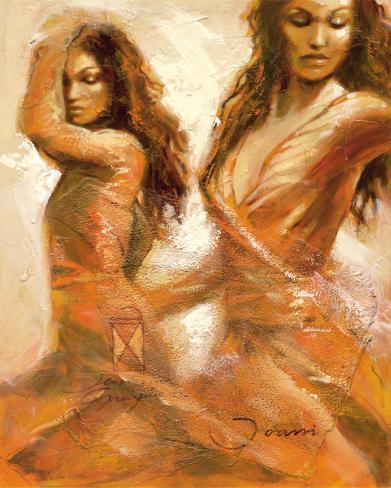
Beauties in Motion by Joani
As seen in one of his pieces, “Beauties in Motion,” there are two women that seem to be dancing; you can see the flow of the fabric creating the skirt of their dresses. The two women look very similar; it could be viewed as the same woman just moving around the canvas. The emotion on the women’s faces can read as being sensual or seductive which Joani likes to portray within his works as well. “ “Passion of Dance,” depicts a man and a woman with a Latin sort of flair, bright colors, dancing passionately. The man is shown dipping the woman, holding her body as she arches back. The bottom of the piece fades in a way and the two are surrounded by a “passionate red.”
Thomas Flair by Peter Jensen
The other artwork in our exhibition by Peter Jensen is “Thomas Flair.” This piece is again a nude male, however this one is made up of polyamide. This man is seen balancing on one hand swinging his legs up and around while his other hand is as well swinging to move to the floor and make his body turn. The movement looks like one of a break dancer on the floor. His artworks are made of many different mediums like bronze, polyamide, and chrome. His works are truly something to be looked at. They capture every ounce of what movements within the human body are.
Heel Kick 002 by Peter Jensen
One artist who truly captures the feel of our exhibition is Peter Jensen. He is a Dutch artist who studied physics and philosophy. He uses movement and shapes of the human body to create energetic artworks. Jensen’s main works are in his line, “Human Motion.” Throughout his works like the two within our exhibition, “Heel Kick 02,” and “Thomas Flair,” the artist captures sequences of human movements in space and time, in a single frame. “Heel Kick 02,” is made of bronze, it depicts a nude man balancing on one foot going through the motions of lifting his left leg to extend out into a high kick. The artwork appears to be many frames taken of this motion combined to create one frame and one image. It appears to be moving, or captured moving, within slow motion
Relativity by Maurits Cornelis Escher
Maurits Cornelis Escher, better known as M.C. Escher, is another amazing artist who likes to play with the mind and logic and the impossible. M.C. Escher is well known for his “impossible structures.” He portrays a world where the laws of gravity are in some words, bended. He studied architecture for a time but ultimately dropped out and decided to become an artist. One of his well-known works, “Relativity,” will be shown in the exhibition. “Relativity,” depicts many featureless faced people walking similarly up and down stairs. However, these stairs and small outdoor areas all have different perspectives4. The viewer ultimately has no way of knowing, which is the “right” way because there probably isn’t one. Escher used these techniques and this style in many of his other works. Throughout the piece you can see the movement of the people and how they are moving along the scenery without hesitation of walking through the impossible world. The artwork is black and white and has many shadows portraying light and dark. It can be seen as sunlight or artificial light within the building, because of the “impossible world,” seen in this piece the viewer does not know the light source or whether the scenery is outdoors or indoors4. The people walking do not have many features and are all almost identical except for in their movements. Each person is moving independently along the scenery, moving about. Escher has a way of playing tricks on the viewers mind and playing with the motion and architecture of his subject matter.
Explosion by Dali
“Explosion.” Explosion shows his famous “soft watch,” which is seen in other works of his. The soft watch is shown up close almost melting and parts of it are twisting and turning its way into the air as if it is spontaneously exploding and floating into the atmosphere. Salvador Dali was very important to the surrealist movement; he was influenced by both contemporary philosophy and science. Sigmund Freud was a key player in the way Dali painted. Dali used many surrealistic aspects to create his paintings; he rejected logic, reason and natural order when painting. He would use these techniques to provoke thought within the audience and viewers of his work. As a viewer, the piece, “Explosion,” is interpreted through my eyes as a way of showing how time moves. How time slips away, though your fingertips without knowing. The movement of the soft watch is depicted as if it’s melting, slipping downward. The movement of the clock in one aspect shows that melting appearance and in some has an exploding appearance5. The exploding pieces of the soft clock I believe portray those “split seconds” in time where everything can change and everything happens incredibly fast. This artwork fits in with the theme of our exhibition showing a different, metaphorical side of movement.
Portrait of Loie Fuller
Loie Fuller was a dancer and theatrical innovator. She started her career young, participating in plays and circuses. She became famous for her Serpentine Dance, where she incorporated her use of voluminous silk skirts that were illuminated by multicolored lighting. The photograph we’re going to be using is a photograph of Loie Fuller mid-dance.
The photograph, titled “Portrait of Loie Fuller” by Fredrick Glasier was done in 1902. This was photographed in one of Loie’s well-known, flowing outfits. It captures her clothes and herself as she was in motion, performing one of her moves. The message of this photograph was not only to use the new photography technology to capture motion, but to also show this woman doing something she was famous for. This photograph captures what Loie Fuller was so well at; it is what made her famous around the world. Even without color, this photograph captures the great detail of her art.
Fuller’s work is still seen today, 120 years after the photograph was taken6. In the Centre Pompidou’s “Dansez sa vie” exhibition, a silent colorized film produced by the Lumiere brothers shows a woman perfuming Fuller’s famous Serpentine Dance (Paris Update). Even though there were no moving images of Fuller performing her dances, they still managed to capture what it must have been like to witness one of them.
The photograph, titled “Portrait of Loie Fuller” by Fredrick Glasier was done in 1902. This was photographed in one of Loie’s well-known, flowing outfits. It captures her clothes and herself as she was in motion, performing one of her moves. The message of this photograph was not only to use the new photography technology to capture motion, but to also show this woman doing something she was famous for. This photograph captures what Loie Fuller was so well at; it is what made her famous around the world. Even without color, this photograph captures the great detail of her art.
Fuller’s work is still seen today, 120 years after the photograph was taken6. In the Centre Pompidou’s “Dansez sa vie” exhibition, a silent colorized film produced by the Lumiere brothers shows a woman perfuming Fuller’s famous Serpentine Dance (Paris Update). Even though there were no moving images of Fuller performing her dances, they still managed to capture what it must have been like to witness one of them.
Morpho Towers- Two Standing Spirals
“Morpho Towers- Two Standing Spirals,” by Sachiko Kodama and Yasushi Miyajima; this artwork is on par with our exhibit. It incorporates both science and art. Kodama and Miyajima use a liquid rich in iron, called a ferrofluid, to create their installation art. The technical details can best be explained by Kodama:
“This technique uses one electromagnet, and its iron core [which] is extended and sculpted. The ferrofluid covers the sculpted surface of a three-dimensional iron shape that was made on an electronic NC lathe. The movement of the spikes in the fluid is controlled dynamically on the surface by adjusting the power of the electromagnet. The shape of the iron body is designed as helical so that the fluid can move to the top of the helical tower when the magnetic field is strong enough 7.“
The main idea of exhibit is to that incorporate the beauty of the science of motion with art. This is a perfect illustration of the theme. It is highly technical and is incredibly beautiful. The incorporation of music with this installation art makes for a wonderful show. The meaning of this art, as explained by the artist, is the harmonization of several opposing properties. These properties are hardness, which is the iron; softness, the fluid the iron is in; freedom, which Kodama explains is the desire for design; and finally restriction, which is explained as the natural powers such as gravity. Kodama says that this artwork can seem like a multitude of different things. It can seem like a horn at some points, and Kodama says it even alludes to the Tower of Babel at one point. This artwork shows the malleability of something perceived to be hard and difficult to bend, and puts it into motion.
Subscribe to:
Comments (Atom)