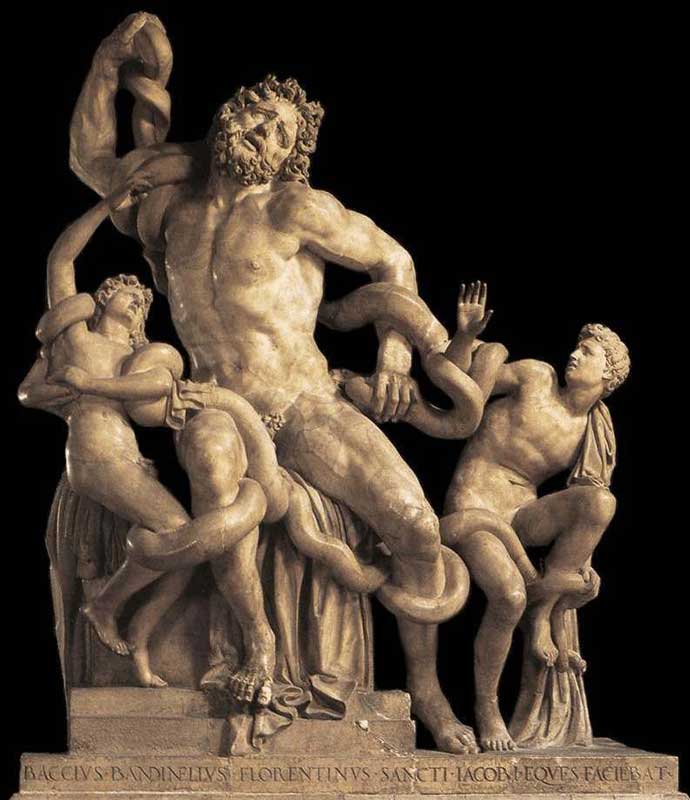
A better-known story having to do with the sculpture has to do with Laocoon and how he had warned against accepting the Trojan horse left by the Greeks. As punishment for betraying his own people he and his sons would be eternally tortured by two serpents sent by the gods. Pliny accredited the sculpture to three Rhodian sculptors, Hagesandros, Polydoros and Athanadoros. The piece is now housed within the Vatican. The Pope of the Catholic Church was astounded by the sculpture and requested it for the Vatican.1
The sculpture is made of marble it was founded in the ruins of the palace of the emperor Titus. When it was founded by Pliny it only had Laocoon and one of his sons, which was then changed to conform to Vergil’s account in the “Aeneid.” Vergil had written about the strangling of Laocoon and his two sons, not one. It was believed that the second son had later been added for this reason.
The sculpture depicts Laocoon, nude and in agony in between his two sons. They are all in great fear of the two serpents surrounding and strangling them. Laoccon still portrays some important Greek sculptural aspects like the perfection of the body.1 He and his sons are in great physical condition, there is cloth draped over the pedestal and one of the sons shoulders, but not much is covered, you can see all aspects of their physique. This was important in Greek culture to depict the importance and greatness of the male body. Upon seeing the sculpture today you can only see one of the snake’s faces, however, it has been determined through the legend and through observation of the sculpture that there were in fact to snakes attacking Laocoon and his two sons. The face of the second snake was broken off, it was believed to have been jabbing at the face of Laocoon as he held its neck to pull it away.
